


The 5-Minute Spanish Challenge: How We're Using Abuela's Visit to Unlock Our Son's Hidden Language
ON THIS PAGE
Subscribe To Get Weekly Family AI Discoveries

My son Mateo understands every word of Spanish. He always has.
When his Colombian grandmother asks him a question in Spanish, he answers perfectly. In English. When my wife speaks to him in Spanish, he follows along completely. Then responds in English.
This is completely normal for bilingual kids where one language dominates socially. We live in Ireland. English is everywhere. Spanish is just... Mam's language.
But last Friday, something changed. His grandmother arrived from Colombia for a five-week visit. And I had an idea.
What if we created a tiny daily challenge? Just five minutes. Spanish only. No pressure, no corrections, no stress. Just five minutes of attempting to speak the language he already knows but has never needed to use.
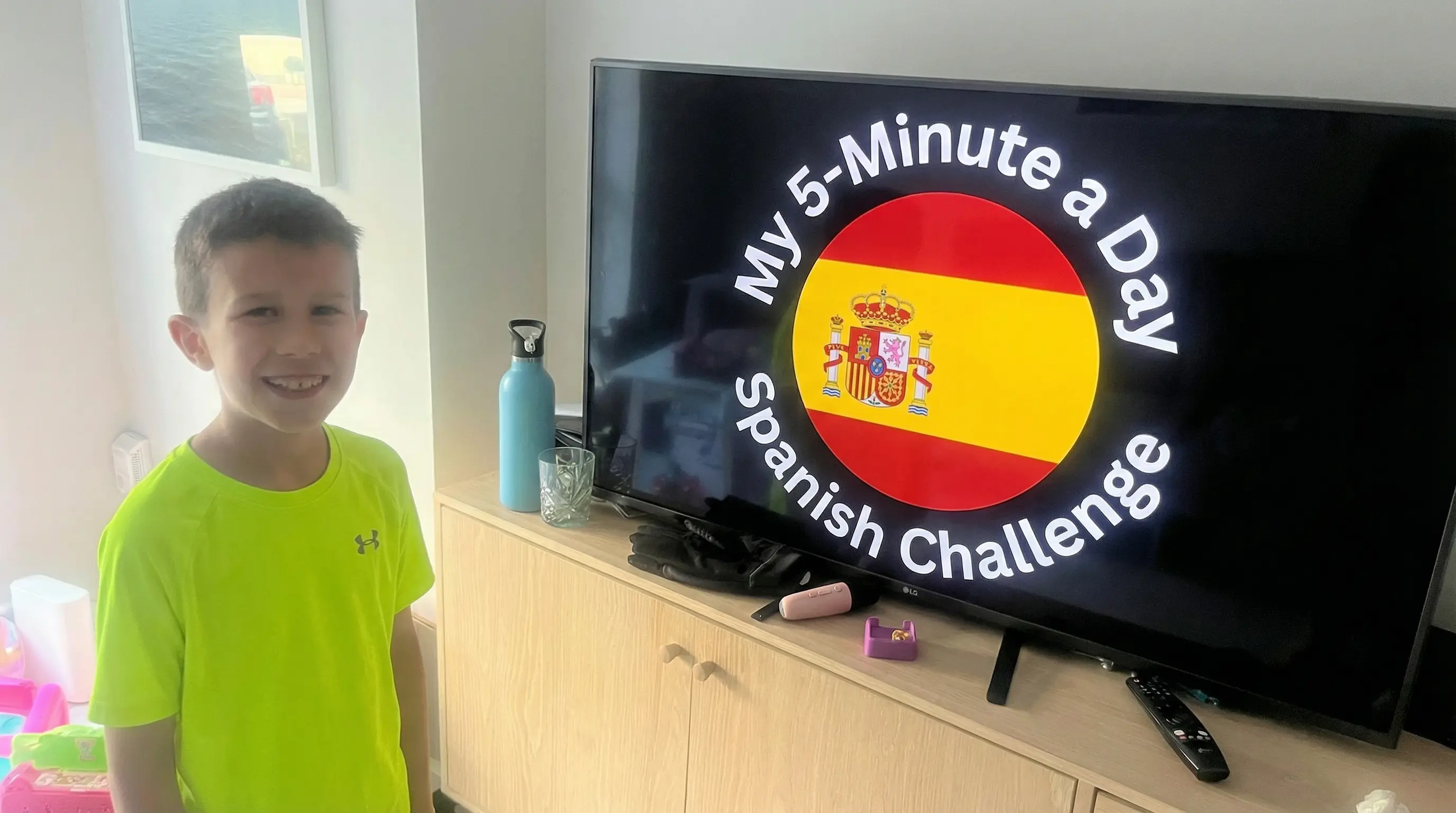
We started on Saturday. The topic was simple: who's taller and who's smaller. It was a struggle. Mateo reached for English constantly. But by the end of those five minutes, he'd strung together his first real Spanish sentences.
"Abuela es más alta que mamá. Yo soy más pequeño que papá."
He grinned. He'd done it.
This guide is the complete 5-week challenge we're running. 25 daily topics organised by theme, with specific prompts, AI tool assists, and a printable tracker. Whether you have a grandparent visiting, a heritage language to preserve, or a bilingual household where one language needs a boost, this framework works.
Five minutes. That's all it takes.
The Rules (Keep These Visible)
- 5 minutes maximum - Stop while it's still fun
- Target language only - Or attempted target language
- No correcting mid-sentence - Let them finish, then gently model the correct version
- Help, prompts, and encouragement allowed - This isn't an exam
- Comprehension → confidence → speaking - That's the progression
Tools
- ChatGPT or Gemini (free) - For generating conversation prompts and quick translations
- Google Translate (free app) - Camera mode for visual learning, audio for pronunciation
- Timer - Phone timer works perfectly
- Printable tracker - Included below
Optional AI Assists
- Voice recorder app - Hearing themselves builds confidence fast
- Image generators - Create scenes to describe in the target language
Time Investment
- Daily challenge: 5 minutes
- Parent prep (if needed): 2 minutes to review prompts
- Total over 5 weeks: ~3 hours
What Your Child Needs
- Passive understanding of the target language
- A conversation partner (grandparent, parent, tutor, or even video call)
- Zero pressure to be perfect
Parent Skills Required
- Basic understanding of the target language (or willingness to learn alongside)
- Patience to sit through pauses and struggles
- Restraint from correcting every error
Not sure which tool is right for your child?
Take our free 2-minute quiz and get personalized AI tool recommendations based on your child's age and interests.
How the 5 Minutes Work (Daily Structure)
Every session follows the same simple pattern:
Minute 1: Warm-Up
Simple yes/no or single-word answers to ease in.
Example: "¿Hace frío hoy?" (Is it cold today?) → "Sí"
Minutes 2-4: The Challenge
Guided conversation around the daily topic. Use the prompts provided. Let them struggle. Offer words when they get stuck, but let them try first.
Minute 5: The Win
End with ONE of these:
- One full sentence they construct themselves
- Acting something out while narrating
- Teaching the grandparent/parent one word they "know well"
Critical: Stop at 5 minutes even if it's going well. Leave them wanting more.
Week 1: Everyday Life (Easy Wins)
Start with familiar, low-stakes topics to build confidence.
Day 1: The Weather
Prompts:
- ¿Qué tiempo hace hoy? (What's the weather like today?)
- ¿Hace frío o calor? (Is it cold or hot?)
- ¿Te gusta este tiempo? (Do you like this weather?)
Sentence goal: Hoy hace frío y está nublado. (Today it's cold and cloudy.)
AI assist: Use Google Translate camera mode - point at the window/sky and learn weather words visually.
Day 2: Clothes
Prompts:
- ¿Qué llevas puesto? (What are you wearing?)
- ¿De qué color es? (What colour is it?)
- ¿Es cómodo? (Is it comfortable?)
Act it out: Touch each item of clothing while naming it.
Day 3: Food You Love
Prompts:
- ¿Cuál es tu comida favorita? (What's your favourite food?)
- ¿Es dulce o salada? (Is it sweet or salty?)
- ¿Te gusta más que...? (Do you like it more than...?)
Fun twist: Compare Irish vs Colombian food with Abuela.
Day 4: Morning Routine
Prompts:
- ¿Qué haces por la mañana? (What do you do in the morning?)
- ¿Primero o después...? (First or after...?)
Sentence goal: Primero me levanto y después desayuno. (First I get up and then I have breakfast.)
Day 5: Feelings
Prompts:
- ¿Cómo te sientes hoy? (How do you feel today?)
- ¿Por qué? (Why?)
Act it out: Happy / tired / excited faces while naming the emotion.
Week 2: Sports (High Motivation Zone)
This is where Mateo lights up. Use their passions.
Day 6: Football
Prompts:
- ¿Te gusta el fútbol? (Do you like football?)
- ¿Qué posición juegas? (What position do you play?)
- ¿Quién es tu jugador favorito? (Who's your favourite player?)
Act it out: Pass an imaginary ball while speaking.
Day 7: Gaelic Football / Hurling
Prompts:
- ¿Es rápido o lento? (Is it fast or slow?)
- ¿Es difícil? (Is it difficult?)
Sentence goal: El hurling es rápido y difícil. (Hurling is fast and difficult.)
Context for Abuela: Explain what hurling is - she'll be fascinated!
Day 8: Swimming
Prompts:
- ¿Te gusta nadar? (Do you like swimming?)
- ¿En el mar o en la piscina? (In the sea or the pool?)
Act it out: Mime different swimming strokes while naming them.
Day 9: Match Day Commentary
The challenge: Narrate ONE football action in Spanish.
"Pasa la pelota... chuta... ¡gol!" (Pass the ball... shoots... goal!)
AI assist: Record it on a voice recorder app. Hearing himself builds confidence fast.
Day 10: Sports Comparison
Prompts:
- ¿Qué es mejor, fútbol o hurling? (What's better, football or hurling?)
- ¿Por qué? (Why?)
Week 3: Games & Tech
FC 26 obsession = endless Spanish conversation opportunities.
Day 11: FC 26 Career Mode
Prompts:
- ¿Qué equipo usas? (What team do you use?)
- ¿Ganaste hoy? (Did you win today?)
- ¿Qué jugador compraste? (What player did you buy?)
Sentence goal: Compré un jugador nuevo. (I bought a new player.)
AI assist: Ask ChatGPT: "How do I say 'I signed Salah for Liverpool' in simple Spanish for an 8-year-old?"
Day 12: Transfers & Teams
Prompts:
- ¿Quién entra? (Who's coming in?)
- ¿Quién sale? (Who's leaving?)
Act it out: Pretend press conference announcing a new signing.
Day 13: Console Rules
Prompts:
- ¿Cuánto tiempo juegas? (How long do you play?)
- ¿Después de qué? (After what?)
Good opportunity to reinforce screen time rules... in Spanish!
Day 14: Create a Player
Prompts:
- ¿Es rápido? (Is he fast?)
- ¿Es fuerte? (Is he strong?)
- ¿Es alto o bajo? (Is he tall or short?)
Optional: Draw a simple stick figure footballer together while describing him.
Day 15: Game Review
Prompt: Complete this sentence:
Me gusta este juego porque... (I like this game because...)
Week 4: Books & Imagination
Diary of a Wimpy Kid provides endless material.
Day 16: Diary of a Wimpy Kid
Prompts:
- ¿Te gusta el libro? (Do you like the book?)
- ¿Es divertido? (Is it funny?)
Day 17: Describe a Character
Prompts:
- ¿Es simpático? (Is he nice?)
- ¿Es gracioso? (Is he funny?)
Sentence goal: Es gracioso y un poco loco. (He's funny and a bit crazy.)
Day 18: Change the Story
Prompt: ¿Qué pasa si...? (What happens if...?)
Act it out: One silly alternate scene.
Day 19: Make Your Own Book
Prompts:
- ¿De qué trata? (What's it about?)
- ¿Quién es el héroe? (Who's the hero?)
AI assist: Use ChatGPT to generate a short story in Spanish + English side-by-side based on his ideas.
Day 20: Read One Line Aloud
Find one simple line in a Spanish book or generated story. Read it aloud.
No pressure on pronunciation - just try.
Week 5: Family & Real Life
The emotional home stretch.
Day 21: Abuela Stories
Prompt: ¿Qué te gusta hacer con la abuela? (What do you like doing with grandma?)
Day 22: Ireland vs Colombia
Prompts:
- ¿Hace más frío dónde? (Where is it colder?)
- ¿Qué comida te gusta más? (What food do you like more?)
Day 23: Your Day
Prompt: Describe one thing you did today.
Hoy fui a... (Today I went to...)
Day 24: Teach Dad One Word
Roles reversed. Mateo teaches ME a Spanish word.
This is a huge confidence booster - he becomes the expert.
Day 25: Celebration Day
The final challenge:
- Pick his favourite topic from the 5 weeks
- Say his favourite sentence
- No corrections at all
Celebrate the progress. Compare Day 1 to Day 25.
What's Working (After Day 2)
The 5-Minute Limit Removes All Resistance
When I told Mateo "just 5 minutes," his shoulders dropped. No stress. He knows there's an end point. This is crucial - the moment it feels like a lesson, motivation dies.
Familiar Topics Reduce Cognitive Load
Day 1 was weather. He already knows the Spanish words for hot, cold, rain, sun. He just needed permission to use them. Starting with vocabulary he already passively knows makes the first attempts feel achievable.
Abuela as Conversation Partner = Emotional Motivation
This wouldn't work as well with me. But his grandmother? He wants to connect with her. The emotional pull is stronger than any reward system.
No Corrections Mid-Sentence
This is hard for parents. He'll say something grammatically wrong. Let it go. After he finishes, you can gently model the correct version: "Ah sí, hace frío" - but don't interrupt the flow.
What We're Adjusting
He Reaches for English Constantly
This is expected. When he switches to English mid-sentence, I just wait. Give him a gentle prompt: "¿En español?" Usually he can find the word if given 5 more seconds.
Some Topics Are Too Hard for Day 1
I had "morning routine" planned for Day 2 originally. Moved it to Day 4. The verb conjugations needed (me levanto, desayuno) were too complex for the first few days. Start simpler.
Why This Approach Works (The Science)
Comprehension → Speaking Is Normal
Kids in bilingual households often have "receptive bilingualism" - they understand everything but don't produce the language. This isn't a failure. It's a normal developmental stage. The language is there, just dormant.
Low Stakes = More Risk-Taking
When there's no grade, no test, no "right answer," kids take more risks. They'll attempt sentences they'd never try in a classroom. Mistakes become experiments, not failures.
Grandparent Visits Are Golden Windows
Research shows that intensive exposure periods (like a grandparent visit) can activate dormant language skills faster than years of weekly lessons. Five weeks of daily practice with a loving conversation partner is powerful.
Using AI as a Helper (Not the Star)
ChatGPT / Gemini for Quick Translations
When Mateo wants to say something specific, we ask ChatGPT:
"How do I say 'I scored a goal with Salah' in simple Spanish for an 8-year-old?"
The AI gives us: "Marqué un gol con Salah."
He repeats it. Done. No dictionary searching, no parent guessing.
Google Translate Camera Mode
Point the phone at objects around the house. The Spanish word appears overlaid on the image. Visual + contextual learning.
This works brilliantly for the "Clothes" challenge - point at his jumper, see "jersey" or "suéter" appear.
Voice Recording for Confidence
On Day 9 (Match Commentary), we recorded Mateo narrating a goal. Playing it back, he heard himself speaking Spanish fluently for 10 seconds. His face lit up. He asked to do it again.
Hearing yourself succeed builds confidence faster than any praise.
Stop While It's Still Fun
The 5-minute limit isn't arbitrary. End the session before frustration sets in. If he's on a roll at minute 4, you might be tempted to keep going. Don't. Stop at 5. He'll be eager to come back tomorrow.
Let Them Choose the Topic Sometimes
The 25-day plan is a guide, not a script. If Mateo wants to spend Day 8 talking about FC 26 instead of swimming, let him. Motivation matters more than sequence.
Use Physical Movement
Acting things out while speaking reduces the cognitive load. When he mimes passing a ball while saying "pasa la pelota," the words come easier. Movement and language reinforce each other.
The "Teach Me" Trick
When he's stuck, ask: "How do you think Abuela would say it?" Or: "Can you teach me that word?"
Switching him from student to teacher often unlocks words he didn't know he knew.
Celebrate the Attempts, Not Perfection
"You said a whole sentence in Spanish!" matters more than "You said it correctly." Accuracy comes with practice. Confidence comes from celebration.
Use His Obsessions
FC 26 appears in Week 3, but honestly, we could do an entire 5 weeks just on football. If your child has a deep interest (dinosaurs, Minecraft, horses), build multiple days around it. Passion fuels persistence.
Problem: They refuse to participate
Solution: Start even smaller. "Can you just say one word in Spanish today?" Remove all pressure. Sometimes Day 1 is just listening to Abuela talk and nodding. That's fine. Participation will come.
Problem: They only respond with single words
Solution: That's perfect for Week 1. Single words build to phrases. Phrases build to sentences. Don't rush the progression.
Problem: They get frustrated and switch to English
Solution: Let them finish in English, then gently translate it back: "Ah, so in Spanish that would be..." Don't force them to repeat it. Just expose them to the correct version.
Problem: The grandparent speaks too fast
Solution: Brief the conversation partner beforehand. "Speak slowly. Use simple sentences. Wait 5-10 seconds for responses." Grandparents sometimes forget that comprehension is faster than production.
Problem: They're embarrassed to speak in front of others
Solution: Make it private. Just child + one adult. No siblings watching. No recording (unless they want to). Create a safe space for mistakes.
Problem: We missed a day
Solution: Skip it entirely or double up casually. Don't make it a big deal. Consistency matters more than perfection. 20 out of 25 days is still a win.
Problem: The child knows more than the parent
Solution: Perfect! Let them teach you. Use ChatGPT to check translations if needed. Your role is facilitator, not expert. Learning alongside them is actually powerful modelling.