


AI Tutor vs AI Assistant: What 2026 Research Tells Parents
ON THIS PAGE
Subscribe To Get Weekly Family AI Discoveries

- "Use AI to study" without structure hurts learning. AI prompted as a tutor with adult support produces large positive effects in the latest research.
- A June 2025 Harvard RCT found AI tutoring beat in-class active learning with effect sizes of 0.73 to 1.3 SD. Students learned more in less time.
- A UK secondary-school trial of 165 students aged 13-15 found a supervised AI tutor outperformed online human tutors at follow-up problem-solving, 66.2% vs 60.7%.
- The mode matters more than the model. Synthesis Tutor, WordLab, and a parent-supervised Claude session all create tutor mode. Generic ChatGPT chat almost never does.
- Real data from WordLab, a constrained vocabulary game tool I built for my own kids: 1,613 games played in 4 weeks, 97% engagement on the strongest game type, kids replaying within sessions.
Ethan Mollick shared a study on X last week that captured something I have been seeing at home for months. The post in one line: "Just having students 'use AI to study' hurts learning. AI prompted to act like a tutor, with teacher support, produces large positive effects."
I have three kids. I have spent 500+ hours testing AI tools with them. The mode you put the AI in matters more than which AI you pick. And yet most parent guides treat "AI for learning" as one thing.
This post pulls together the recent research on what actually works (three 2026 trials and counting), explains the difference between tutor mode and assistant mode in plain terms, and shows what tutor mode looks like at home. There is also a section with real data from WordLab, the vocabulary game tool I built for my own kids, that lines up with the research findings in a way I did not expect.
If you have been wondering whether AI is good or bad for your child's learning, that is the wrong question. Here is the right one.
Not sure which tool is right for your child?
Take our free 2-minute quiz and get personalized AI tool recommendations based on your child's age and interests.
The right question is "which mode," not "whether"
When parents ask me "is AI good or bad for kids' learning?" I cannot answer. The question does not have one answer. It is like asking "is talking good or bad for kids?" Depends entirely on what is being said.
Here is the cleaner framing the research supports.
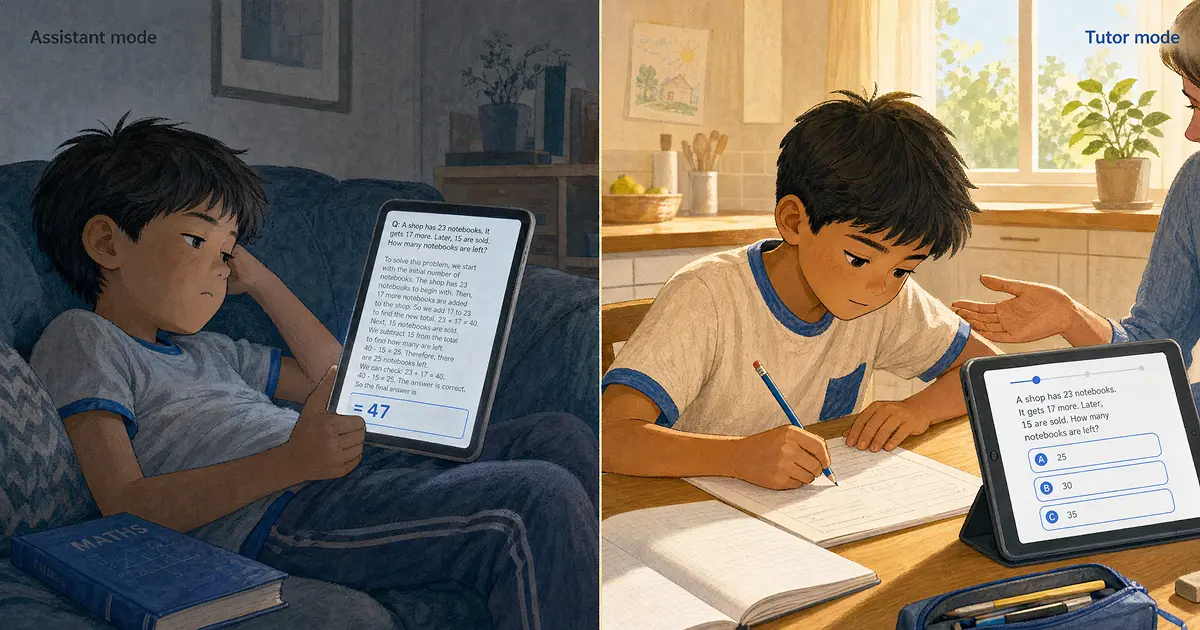
Assistant mode. Open chatbot interface. The kid types a question or pastes a homework problem. The AI gives the answer. Or a long explanation that ends with the answer. The kid copies it down or scans the explanation enough to fake understanding for the next ten minutes.
Tutor mode. Structured interaction where the AI asks questions, holds the answer back, scaffolds difficulty, and forces the kid to do the thinking. Plus an adult somewhere in the loop providing setup, monitoring, or checking.
The research findings are clean. Assistant mode hurts. Tutor mode helps, often dramatically.
What 2026 research actually shows
Three randomised trials, all pointing the same way.
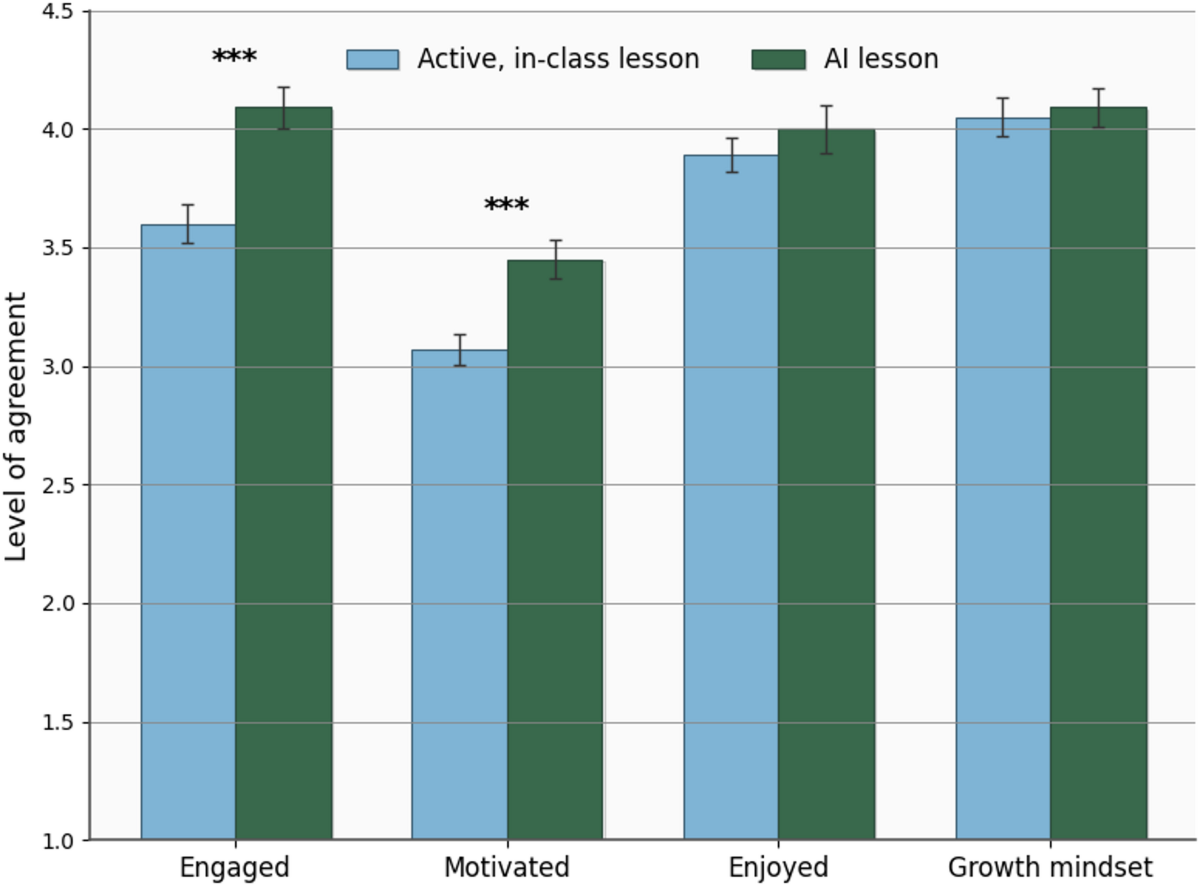
Harvard, Scientific Reports (June 2025). AI tutor beat in-class active learning by 0.73 to 1.3 standard deviations. That is not a tweak. It is the gap between an average student and a strong one. Students learned more in 49 minutes than in 60 minutes of the standard class.
UK secondary RCT (165 students, ages 13-15). Supervised AI tutor outperformed online human tutors at follow-up problem-solving, 66.2% vs 60.7%. These were real teenagers in real classrooms, not college students.
AI assisting human tutors (math). Students were 4 percentage points more likely to progress when their tutor used AI assistance. The biggest lift was for less-experienced tutors. This is the at-home parallel: you are the tutor, AI is your assistant.
One caveat worth knowing. The specific paper Mollick linked actually compared personalised problem ordering versus standard ordering, not AI tutor vs no AI. The three studies above stand without it.
💡 Parent Insight: The research is more nuanced than the headlines, but the direction is consistent. Tutor mode beats assistant mode across three independent trials. Bet your kid's study time on that asymmetry.
What "tutor mode" looks like at home
Four configurations that put AI into tutor mode for kids. None of these are theoretical. We use all four in our house.
1. Purpose-built tutor tools
The cleanest example is Synthesis Tutor, which is literally called "Synthesis Tutor" and was designed from the ground up to scaffold maths learning. It asks questions, withholds answers, escalates difficulty when the child gets things right, drops back when they don't.
Khanmigo (Khan Academy's AI) is the close second for maths. It chats more conversationally than Synthesis but the underlying structure is similar. We have a full head-to-head at Synthesis Tutor vs Khanmigo.
These tools come with tutor mode baked in. You cannot easily break them out of it. The persona, in the words of one reply to Mollick's post, "cannot be bypassed."
2. Constrained-interface single-purpose tools
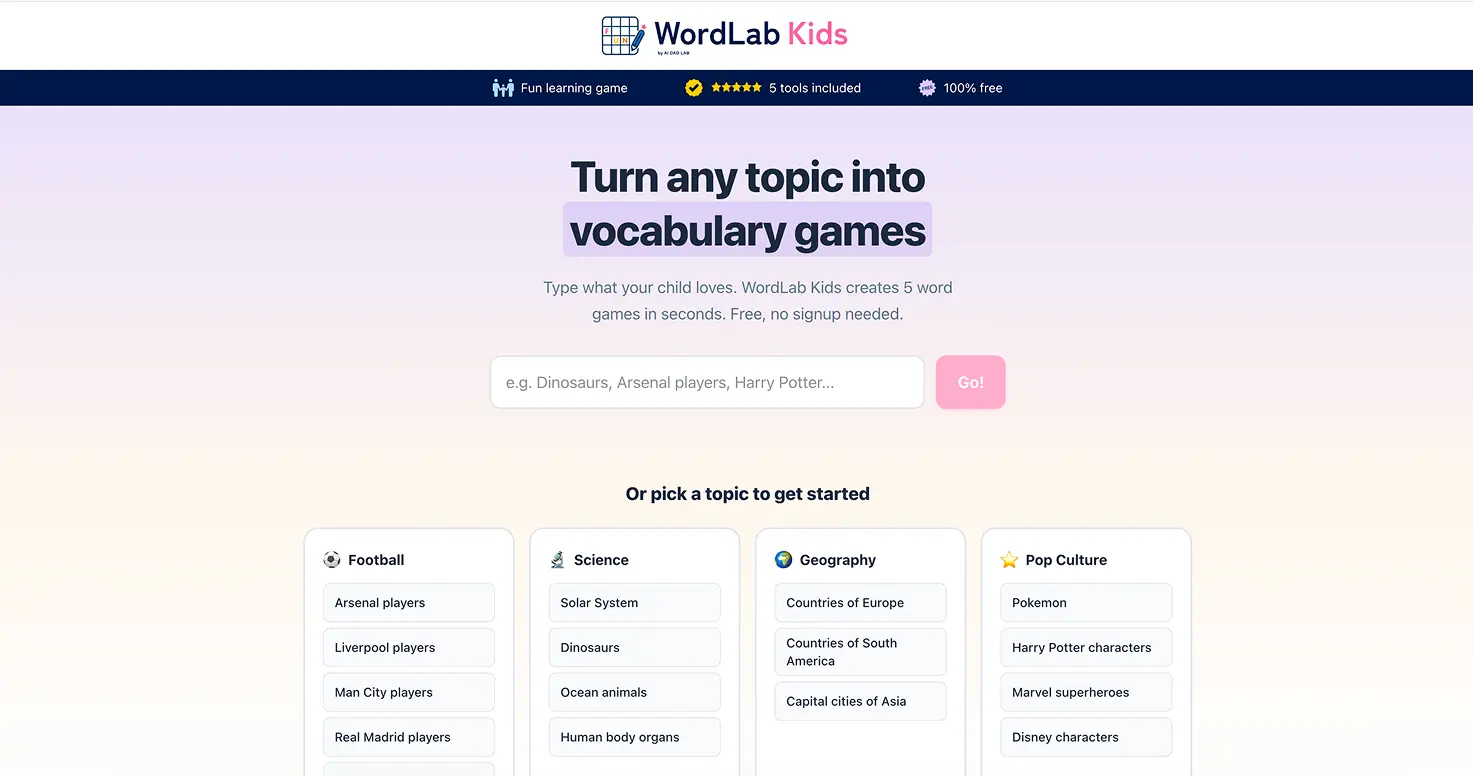
Step down a level. Tools that are not called "tutor" but enforce a structured interaction by virtue of how the UI is built. WordLab is this. Your child types a topic ("Harry Potter," "solar system," "Arsenal players"), and gets five word games on that topic: crossword, word search, unjumble, missing letters, who am I. There is no chat box. There is no "ask the AI for help." The kid plays the game, the kid does the thinking.
That is tutor mode by enforcement. The kid cannot ask the AI for the answer because the AI's only job is generating the puzzle. We will come back to WordLab's actual usage data in a moment because the engagement numbers say something interesting.
3. Parent-supervised general chatbots with structured prompts
This is what we cover in detail in our AI homework practice exercises post. Take a photo of your child's homework. Open Claude. Use a structured prompt: "Generate 10 similar exercises at this difficulty level, with an answer key on a separate page." Print. Hand it to your child. Check the answer key. Sit alongside.
The AI never talks to the child directly. The parent provides the structure. The child does the work on paper. This is the at-home version of the "AI assistant to human tutors" setup, where you (the parent) are the tutor and Claude is your assistant.
4. What NOT to do
The thing the research shows hurts learning: hand a kid open-ended ChatGPT and tell them "use this to study." Without scaffolding, kids will short-circuit. They will ask for the answer. They will paraphrase the AI's explanation back to themselves and feel like they have learned. Their grades on graded homework go up. Their test scores often go down. We covered this dynamic in Is AI making kids lazy? from earlier this year.
This is what Mollick's post is warning about. The mode is the warning, not the model.
Real data from a tool I built
I built WordLab for my 8-year-old son. He has a weekly spelling workbook from school with five exercises: word search, crossword, unjumble, missing letters, "Who Am I" clues. He is good at them. They take ten minutes. Then he is done.
I wanted him to do those same five exercises but on topics he actually cares about. Arsenal players. Premier League. Star Wars. The tool generates the games on whatever topic gets typed in. We launched four weeks ago.
Four weeks of data:
| Metric | Value |
|---|---|
| All-time games played | 1,613 |
| All-time topics created | 582 |
| All-time game completions | 592 |
| Last 7 days: sessions | 1,396 |
| Last 7 days: games played | 374 |
| Last 7 days: completions | 139 |
| Avg session duration (current) | 1.6 min |
| /wordlab/who-am-i page engagement rate | 97% |
| Who Am I plays per week | 65 (highest) |
| Who Am I completion rate | 23% (lowest) |
| Word Search completion-to-start ratio | Over 1.0 (replay) |
What lines up with the research:
Constrained tools drive engagement. The /wordlab/who-am-i page has a 97% engagement rate. That is near-impossible to hit with general content. The reason is the same as the Synthesis Tutor reason. Kids cannot bail out into a chat tangent. The interface forces them to play.
Replay rates above 1.0 mean kids are doing multiple puzzles per session. Word Search showed more completions than starts in the last 7 days, which means kids are completing puzzles across sessions or doing multiple in a single visit. That is tutor-mode behaviour. The activity is satisfying enough to repeat.
The Who Am I tension is interesting. It is the most-played game (65 plays per week) but has the lowest completion rate (23%). Two possible reads. One: it is harder than the other games, so kids get stuck and bail. Two: kids enjoy reading the clues even when they do not formally complete the puzzle. I lean toward the first and we are tweaking the difficulty calibration.
Topic mix is wide and intrinsic. Recent topics include "solar system," "Harry Potter," "Harry Potter Gringotts." Kids are choosing what they care about, not what their teacher assigned. The intrinsic motivation is doing some of the work the tutor mode normally has to.
If you want to try it with your child, it is at wordlab.aitoolsforkids.com. Free, no signup. Parent-led for under-7s, independent for 8+.
💡 Parent Insight: The takeaway from four weeks of WordLab data: kids do not need an AI that can do everything. They need one that does one thing well, with no escape hatch. Constraint is a feature for learning tools, not a bug.
Want one tested AI tool every Friday? I send one practical recommendation per week, tested with my kids that same week. No fluff, no sponsors. Join 500+ parents in the newsletter →
What this means for your kid
Four-step pattern that lines up with the research.
- Match the mode to the task. Maths drilling? Synthesis Tutor or Khanmigo. Vocabulary or spelling? WordLab. Homework practice on a specific subject? Parent-prompted Claude generating worksheets. Do not use a chatbot for any of these unless you are providing the structure.
- Scaffold the structure yourself if the tool does not. If you are using a general chatbot, you provide the tutor mode. The kid does the thinking, the AI generates the practice material. You sit alongside, check the answer key, ask follow-up questions.
- Check the answer key. AI gets things wrong. Maths is the easiest place to spot it (a wrong sum is wrong) but spelling, definitions, and dates are equally exposed. Two minutes of checking before you hand the sheet over.
- Watch what happens when you remove the structure. Most kids will short-circuit if you give them an open chat. The dropoff in retention is the signal that the mode mattered.
A quick tools reference
| Tool | Mode | Best for | Cost |
|---|---|---|---|
| Synthesis Tutor | Purpose-built tutor | Math, ages 5-11 | $20/month |
| Khanmigo | Conversational tutor | Math, ages 9+ | $4/month |
| WordLab | Constrained game tool | Vocabulary, spelling, ages 5-12 | Free |
| Claude (with parent prompts) | Parent-scaffolded | Any subject, parent-led | Free tier works |
| ❌ Generic ChatGPT (kid-led) | Assistant, avoid | Nothing for studying | Free tier works |
For the full Synthesis vs Khanmigo head-to-head with our family testing, see our comparison post. For the parent-prompted Claude workflow with photographs of homework, see our homework practice exercises guide.
💡 Parent Insight: If you take one thing away from this post: the next time your kid says "I am using AI to study," ask them to show you what they are doing. If the AI is generating answers, intervene. If the AI is generating questions, walk away.
Final take
Mollick's framing was right and underdiscussed. "Use AI to study" is not one thing. There is a mode that helps and a mode that hurts, and the gap between them is large enough to show up in randomised trials with effect sizes you do not usually see in education research.
The good news for parents: tutor mode is achievable at home with tools that exist today. Synthesis Tutor for math. WordLab for vocab. Claude with structured prompts for everything else. The work is not picking the model. It is matching the mode to the task and not bailing out into the open chat.
Get a tested AI tool every Friday. I send one practical recommendation per week, tested with my kids that same week. No fluff, no sponsors, just what worked. Join 500+ parents in the AI Tools for Kids newsletter.
Sources
- AI tutoring outperforms in-class active learning (Scientific Reports, June 2025)
- What the research shows about generative AI in tutoring (Brookings)
- AI Tutors with human help offer reliable instruction (The 74 Million)
- Systematic review of AI-driven intelligent tutoring systems in K-12 (PMC)
- How AI can improve tutor effectiveness (Stanford SCALE)
- Mollick's X post and full thread (29 April 2026)