


8 Free AI Games for Kids: No Signup, Tested With My Kids (2026)
ON THIS PAGE
Subscribe To Get Weekly Family AI Discoveries

- Most of the best AI games for kids are completely free and need no account to start
- Quick, Draw! and Code.org AI for Oceans work for kids as young as 5 with zero setup
- Free tiers on tools like Nano Banana 2 and LittleLit are generous enough for regular use
- Older kids (8+) get more from Teachable Machine and Infinite Craft where they build something
- Start with one tool, let your child explore for 15 minutes, then decide if it sticks
Every time I find a new AI tool for kids, the first thing I check is whether my children can actually use it without me handing over an email address or credit card. You'd be surprised how many "free" tools aren't really free once you click through.
Over the past year, I've tested dozens of AI games with my three kids (ages 3, 6, and 8). Some held their attention for 30 seconds. Others became weekly favourites. The ones that stuck all had something in common: they were genuinely free, required no signup, and let the kids do something creative within the first minute.
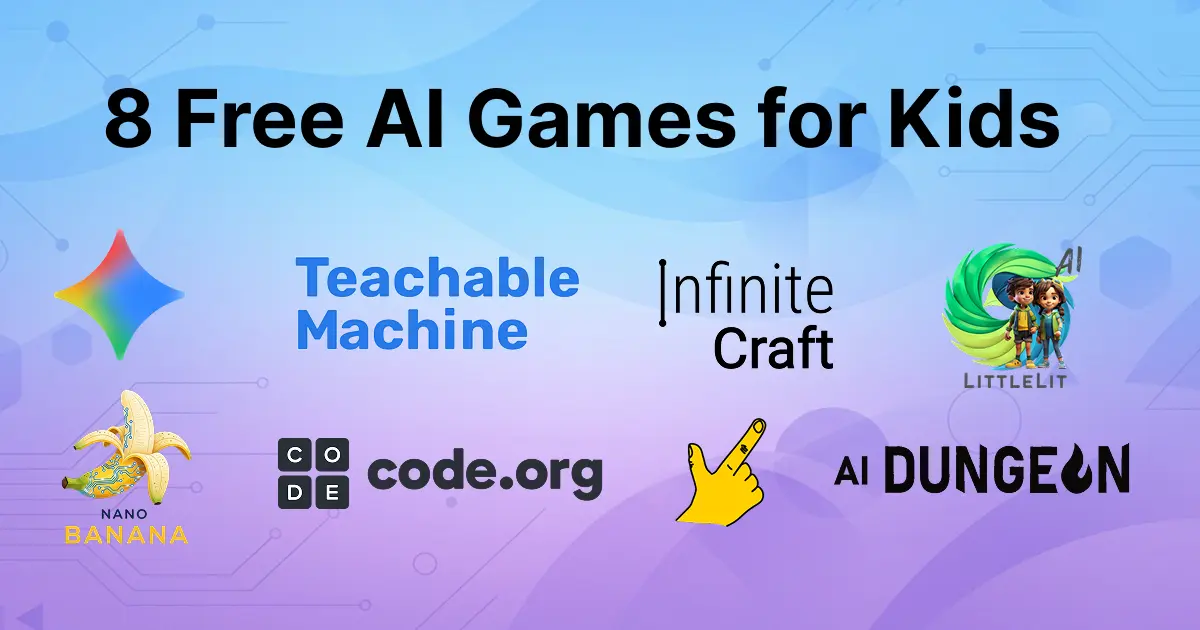
This guide covers the 8 free AI games that actually worked in our house, sorted by age. Every tool here is either completely free or has a free tier generous enough that you won't hit a paywall during a single session.
Not sure which tool is right for your child?
Take our free 2-minute quiz and get personalized AI tool recommendations based on your child's age and interests.
What "free" actually means (and what to watch for)
Before the list, a quick reality check. I've split these into two categories:
- Truly free, no signup: Open a browser, start playing. No email, no account, no credit card. Quick, Draw! and Code.org fall into this group.
- Free tier with account: You need to create a parent account, but the free plan is generous enough for regular use. Nano Banana 2 and LittleLit work this way.
I've flagged which category each tool falls into below. The no-signup options are better for privacy since there's literally no data to collect. The free-tier tools tend to offer more depth in exchange for that account creation.
8 free AI games we've tested with our kids
1. Quick, Draw! (ages 5+, no signup)
What it is: Google's drawing game where you sketch something in 20 seconds and the AI tries to guess what it is.
Cost: Completely free. No account needed. Works in any browser.
What happened when we tested it: My 8-year-old was hooked immediately. He played 6 rounds straight before I could get him to stop. My 6-year-old found it trickier (the 20-second timer is stressful when you're still learning to draw a bicycle), but she loved watching the AI's guesses scroll past. My 3-year-old scribbled happily while his siblings played, though the AI didn't guess "dinosaur" from his circles.
Why it's good: It's the simplest way to show kids how AI "sees" things. After a few rounds, my 8-year-old started asking why the AI guessed "chair" when he drew a table. That's machine learning concepts absorbed through play, no lesson plan needed.
Supervision level: None needed. No chat, no user-generated content, no way to encounter anything unexpected.
Read our full Quick, Draw! review for more details.
2. Code.org AI for Oceans (ages 5-8, no signup)
What it is: A short, guided activity where kids train an AI model to sort ocean trash from sea creatures by dragging examples into categories.
Cost: Completely free. No account needed.
What happened when we tested it: My 6-year-old finished the whole module in about 15 minutes and asked to do it again. She understood the core concept surprisingly fast: "I'm teaching the computer what fish look like." My 8-year-old found it a bit easy but appreciated the ocean theme.
Why it's good: It's one of the only tools that teaches kids what training data actually means without using those words. The interface is colourful, the instructions are clear, and it works on tablets. Code.org also has a broader "Hour of AI" set of activities if your child wants more after finishing this one.
Supervision level: Minimal. The content is entirely pre-built and educational.
3. Infinite Craft (ages 6+, no signup)
What it is: A browser game where you combine elements (fire, water, earth, wind) to discover new ones. AI generates the combinations, so the possibilities are essentially endless.
Cost: Completely free. No account needed.
What happened when we tested it: This became a genuine obsession in our house for about two weeks. My 8-year-old spent an entire Saturday afternoon combining things to see what he could create. His proudest moment: combining "dragon" and "ice cream" to get "dragon ice cream." My 6-year-old needed help reading some of the words but loved the discovery loop of trying combinations.
Why it's good: The "what happens if I combine X and Y?" loop is perfectly tuned for curious kids. There's no failure state, no timer, no pressure. You just experiment. It's also a sneaky way to build vocabulary since every new discovery is a word or phrase.
Supervision level: Low. Some combinations can produce mildly silly results ("toilet" + anything tends to amuse 8-year-olds), but nothing inappropriate in our testing.
4. Google Teachable Machine (ages 8+, no signup)
What it is: A browser tool where kids train their own AI model using their webcam, sounds, or body poses. They create categories, provide examples, and watch the AI learn in real time.
Cost: Completely free. No account needed (though you can save projects to Google Drive).
What happened when we tested it: My 8-year-old trained a model to recognise his different facial expressions (happy, sad, surprised) in about 10 minutes. The moment the AI correctly identified his "angry face" in real time, he was genuinely amazed. He then spent another 20 minutes training it to distinguish between his toy cars by colour. My 6-year-old watched but found the setup steps too complex to do independently.
Why it's good: This is the closest thing to "real" machine learning a kid can do without writing code. They see exactly how training data works: more examples = better accuracy. My son figured out on his own that the AI got confused when the lighting changed, which is a genuine insight into how computer vision actually works.
Supervision level: Uses the webcam, so worth being present. No internet connection to other users though.
See our Teachable Machine page for setup tips.
Want to see how free tools stack up against paid ones? We compared the costs across 12 categories in our Free vs. Paid AI Tools for Kids guide. Spoiler: most families never need to leave the free tier.
5. Nano Banana 2 (ages 5+, free tier with account)
What it is: Google's AI-powered image generator designed for kids. Type a prompt, get an image. The free tier gives you a set number of generations per day.
Cost: Free tier available. Requires a Google account (parent's account works fine).
What happened when we tested it: My 6-year-old's first prompt was "a cat wearing a crown in space" and the result made her squeal. She generated about 15 images in one sitting before we hit the daily limit. My 8-year-old used it more strategically, trying to create characters for a story he was writing. The free tier was enough for a solid 20-30 minute session.
Why it's good: The content filters are strong (it's Google, aimed at kids), so I didn't worry about inappropriate outputs. The interface is simple enough that my 6-year-old could type prompts with minimal help. It's a great first step into AI image generation without the safety concerns of adult tools.
Supervision level: Low. Content filters handle most concerns. Worth being nearby for younger kids who need help typing.
Read our full Nano Banana review review, or try our AI colouring pages project project to turn generated images into printable colouring pages.
6. LittleLit (ages 3-8, free tier with account)
What it is: A creative studio designed specifically for kids. Children create stories, artwork, and animations using AI, with parental controls built in. COPPA-compliant with explicit privacy protections for under-13s.
Cost: Free tier available. Requires a parent account.
What happened when we tested it: My 6-year-old made a short animated story about a "magic puppy" in about 20 minutes. The guided interface meant she didn't need to type complex prompts. Even my 3-year-old could tap through some of the simpler creation tools with help. My 8-year-old thought it was "a bit babyish" but still spent 15 minutes making a comic strip.
Why it's good: It's one of the few AI tools built from the ground up for young children. The COPPA compliance and parental controls aren't afterthoughts. The free tier is limited but enough to see if your child connects with it before upgrading.
Supervision level: Minimal for ages 5+. The parental dashboard lets you review what your child creates.
See our full LittleLit review.
7. Google Arts & Culture experiments (ages 6+, no signup)
What it is: A collection of AI-powered mini-experiments from Google. Highlights include "Say What You See" (describe what's in a painting and the AI checks your answer), and art-matching games that use machine learning to connect your selfie to famous artworks.
Cost: Completely free. No account needed.
What happened when we tested it: My 8-year-old loved the selfie-to-artwork matcher. He took about 20 selfies trying to get matched with different paintings. My 6-year-old preferred "Say What You See" because it felt like a guessing game she could actually win. These are shorter experiences (5-10 minutes each), so they work well as "AI snacks" rather than main activities.
Why it's good: It connects AI to art and culture rather than just tech. The experiments are varied enough that different ages find different ones appealing. And since they're browser-based Google experiments, they work reliably on any device.
Supervision level: None needed. All content is curated artwork and educational.
8. AI Dungeon (ages 13+, free tier with account)
What it is: A text-based adventure game powered by AI. You type what your character does, and the AI generates what happens next. Think choose-your-own-adventure, but with infinite possibilities.
Cost: Free tier available with limited daily actions. Requires an account.
What happened when we tested it: This one is for my 8-year-old only, and with me sitting next to him. He created a story about a knight finding a dragon's treasure, and the AI kept the narrative going for about 30 minutes. He loved that his choices actually changed the story. I had to redirect once when the story got a bit dark (the AI introduced a "mysterious stranger" that felt too intense), but the safe mode default kept things mostly on track.
Why it's good: For older kids who love reading and storytelling, it's genuinely creative. The AI responds to anything they write, which makes it feel like magic. It's also good practice for descriptive writing since better prompts create better stories.
Supervision level: High. AI Dungeon's own guidelines position it for teens. The AI can generate unexpected content even in safe mode. Sit with your child for this one.
See our AI Dungeon page for age guidance and safety settings.
Quick comparison
ToolAgesSignup?SupervisionWhat they makeQuick, Draw!5+NoNoneDrawingsCode.org AI for Oceans5-8NoMinimalTrained AI modelInfinite Craft6+NoLowNew elementsTeachable Machine8+NoPresentML modelNano Banana 25+Yes (Google)LowAI imagesLittleLit3-8Yes (parent)MinimalStories, artArts & Culture6+NoNoneArt matchesAI Dungeon13+YesHighStories
Which free AI game should your kid try first?
Don't overthink it. Pick one based on age and see what happens:
- Ages 3-5: Start with LittleLit. The guided interface means they can create something without reading or typing much. Quick, Draw! also works if you sit together.
- Ages 5-7: Quick, Draw! or Code.org AI for Oceans. Both are instant, no setup, and kids this age love the immediate feedback. If they want to make pictures, try Nano Banana 2.
- Ages 8-10: Infinite Craft or Teachable Machine. These give older kids more agency and something to genuinely explore. Infinite Craft for the "what if" kids. Teachable Machine for the "how does this work" kids.
- Ages 11+: AI Dungeon with a parent nearby, or Teachable Machine for more advanced projects. Google Arts & Culture experiments are also good for this age since the cultural context adds depth.
The most important thing: let them lead. My 8-year-old ignored every tool I recommended and went straight for Infinite Craft because his friend at school told him about it. That turned into two weeks of daily play. The best free AI game is the one your child actually wants to use.
What we skip (and why)
A few tools that come up in "free AI games" searches that I don't recommend for kids:
- Character.AI: Free, but it's an open-ended chatbot with a history of safety issues for younger users. Character.AI restricted under-18 access in late 2025 after significant concerns. I'd avoid it entirely for under-13s.
- ChatGPT as a "game": Some sites suggest using ChatGPT for games like 20 Questions. It works, but it's not designed for kids, there are no content filters tuned for children, and it requires an account. Better options exist.
- "Free trial" tools: Anything that says "free for 7 days" then charges. That's not free, that's marketing. I've excluded every tool that works this way.
The bottom line
You don't need to spend anything to give your kids a solid introduction to AI. The four no-signup tools (Quick, Draw!, Code.org, Infinite Craft, and Google Arts & Culture) cover ages 5-12 with zero friction. Add Nano Banana 2 or LittleLit if your child wants to create things, and AI Dungeon for teens who love storytelling.
For the full list including paid options and deeper reviews, see our Best AI Games for Kids roundup.
Get a tested AI tool every Friday. I send one free tool recommendation per week, tested with my kids that same week. No fluff, no sponsors, just what actually worked. Join 135 parents in the AI Tools for Kids newsletter.